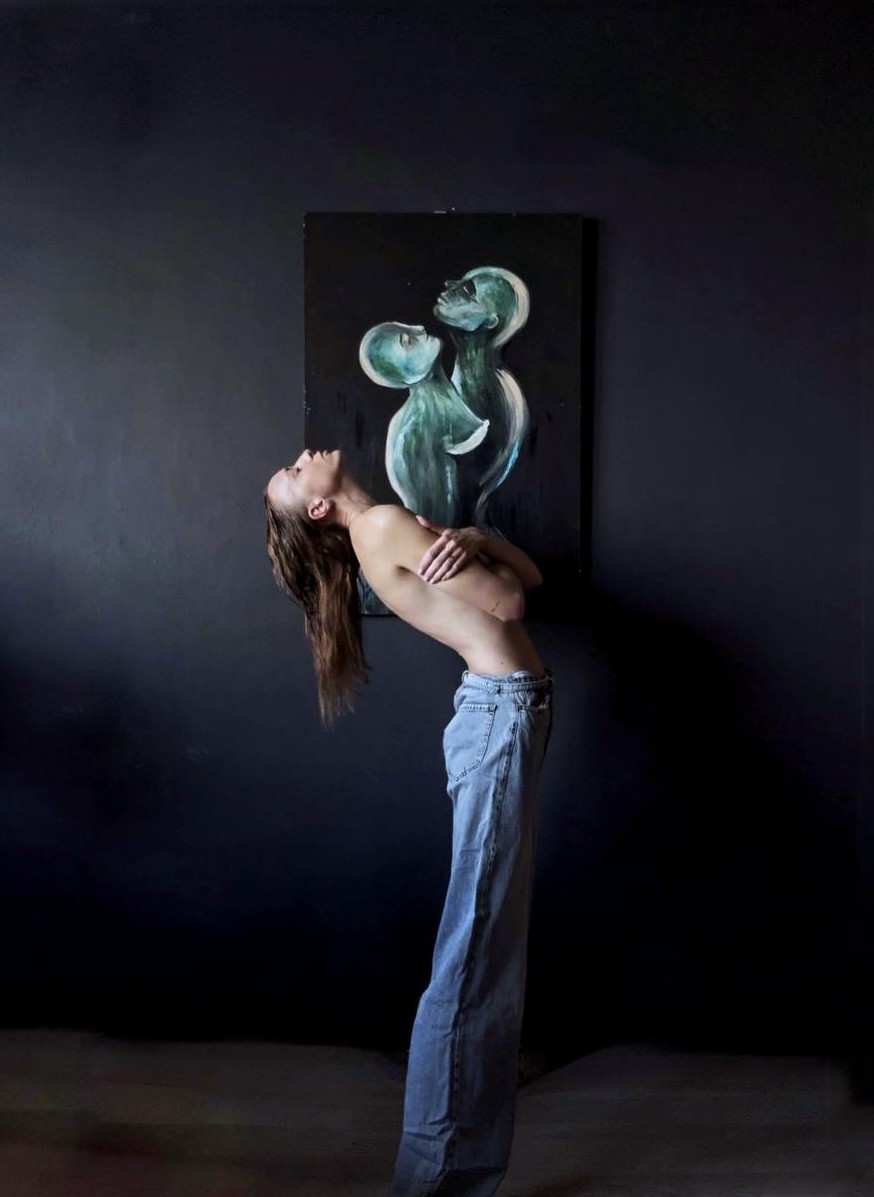
I removed the face from the human figure.
Not because the face no longer interests me, but because it tells us too much.
A name tells us who we are.
Age tells us how long we have been here.
An expression tells us what is happening to us now.
And I wanted to leave only what cannot be pretended.
A state of being.
My medical education taught me to see the body from within — its structure, movement, tension, and interconnectedness. In my artistic practice, I gradually began searching for another way to speak about the body: not as anatomy, but as a place where our inner experience lives.
This is how HELYRA emerged — a world inhabited by souls.
There are no people here in the conventional sense. No names, faces, or predetermined stories. There are organic figures, each existing within its own state of being. They may encounter one another, drift apart, move closer, protect, lose, recognize one another, or remain entirely alone.
In HELYRA, form never exists for the sake of form alone.
The curve of a body, its weight, the direction of its movement, the tension of the spine, the density of its material, or its almost complete disappearance — all of these become part of the soul's inner state.
I work with acrylic on black canvas, leaving the physical presence of the painting visible: the trace of the brush, dry paint, translucent layers, and areas where the black of the canvas becomes part of the figure itself. I want each soul to feel unfinished and alive — as if it exists in the present moment, somewhere between the body and something that can no longer be called a body.
HELYRA is not a world of characters. It is a world of states of being.
There is no right way to look at it. No single meaning. There is only an encounter — between you and whatever you see.
Perhaps, one day, among these souls, you will recognize something of your own. Not a story, not a face, not a particular memory — but a state of being that has already lived inside you.
Listen to it.
Perhaps it is your soul.